
Product Overview
The CJ85/NC is a compact and high-performance fire resistant marine cable, designed with a streamlined construction that omits a separate inner sheath. It combines a fire-survival core of Mica Glass Tape + XLPE insulation (IEC 60331) with a flexible tinned copper wire braid armor and a robust, high-grade Cross-linked Polyolefin (SHF2) outer sheath. This design delivers certified circuit integrity during a fire, superior long-term sheath durability, and excellent mechanical protection in a more efficient package, ideal for space-constrained or demanding installations in critical marine and industrial environments.
Features & Benefits
-
Certified Fire Resistance (IEC 60331): Ensures vital emergency circuits (e.g., emergency lighting, fire alarms, pump controls) maintain operation for a specified duration under fire conditions, which is crucial for life safety and asset protection.
-
Compact & Efficient Structure: The absence of a separate inner sheath results in a more streamlined and potentially lighter cable, optimizing space and material use while maintaining all essential protective functions.
-
High-Performance Outer Sheath (SHF2): The Cross-linked Polyolefin (SHF2) outer sheath provides exceptional resistance to high temperatures, deformation, cracking, chemicals, and abrasion, far exceeding the performance of standard thermoplastic sheaths.
-
Flexible & Corrosion-Resistant Armor: A braid of tinned copper wires offers excellent flexibility for installation, ease of termination, and reliable corrosion resistance in marine and humid environments.
-
Enhanced Fire Safety (LSZH): As an NC-grade cable, it is Halogen Free and Low Smoke, minimizing corrosive gas emission and smoke density to facilitate safer evacuation and protect equipment.
Cable Construction
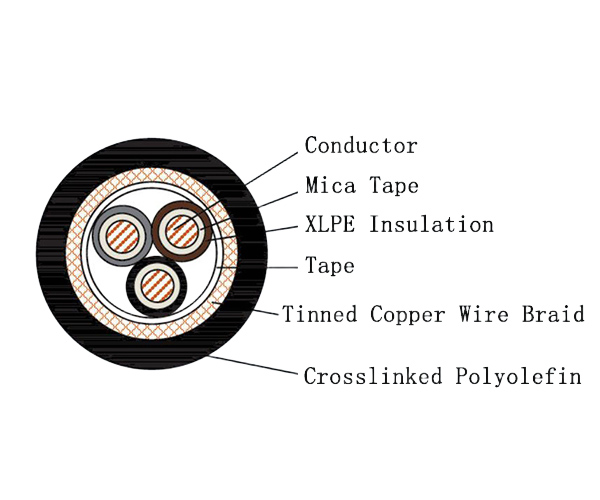
| Item | Code | Material / Description |
|---|---|---|
| Series Code | C | Marine Power Cable |
| Conductor | / | Tinned or Plain Stranded Annealed Copper Wire (IEC 60228) |
| Insulation | J | Mica Glass Tape + XLPE Insulated |
| Inner Sheath | \ | None (No separate inner sheath) |
| Armour | 8 | Braid of Tinned or Plain Copper Wires |
| Outer Sheath | 5 | Cross-linked Polyolefin (SHF2) - Halogen Free, Low Smoke |
| Flammability Class | NC | Halogen Free, Low Smoke, Fire Resistant |
| Sheath Colour | / | Standard Black (Other colours on request) |
Technical Specifications
| Parameter | Specification |
|---|---|
| Rated Voltage | 0.6/1 kV |
| Maximum Operating Temperature | 90°C |
| Conductor | Plain or Tinned Annealed Copper, Stranded |
| Insulation | Mica Glass Tape + Cross-Linked Polyethylene (XLPE) |
| Armour | Braided Tinned/Plain Copper Wires |
| Outer Sheath | Cross-linked Polyolefin (SHF2) |
| Fire Resistance | IEC 60331 |
| Flame Retardancy | IEC 60332-1 & IEC 60332-3-22 (Category A) |
| Halogen Content | IEC 60754-1 (Halogen Free) |
| Smoke Density | IEC 61034-2 (Low Smoke) |
| Core Range | 1 to 37 cores |
| Cross-Sectional Area | 0.75 mm² to 300 mm² |
Standards & Approvals
Manufactured to the highest international standards for fire safety, marine application, and material performance:
-
IEC 60092-350, 353: Electrical installations in ships – Design.
-
IEC 60228: Conductors of insulated cables.
-
IEC 60092-360: Insulating and sheathing materials.
-
IEC 60331: Tests for fire resistant characteristics.
-
IEC 60332-1 & -3-22: Tests for flame retardancy.
-
IEC 60754-1: Test on gases evolved during combustion (Halogen Free).
-
IEC 61034-2: Measurement of smoke density (Low Smoke).
Typical Applications
-
Marine & Offshore: Critical emergency and safety circuits on ships, offshore platforms, and in engine rooms where space is at a premium, and a compact yet high-performance fire-resistant cable is required. Ideal for emergency lighting, alarm systems, and control circuits for essential services.
-
Industrial & High-Risk Facilities: Power supply for life-safety systems in industrial plants, power generation facilities, and tunnels where the combination of fire survival, a durable SHF2 sheath for harsh environments, and a compact cable design are key requirements.