
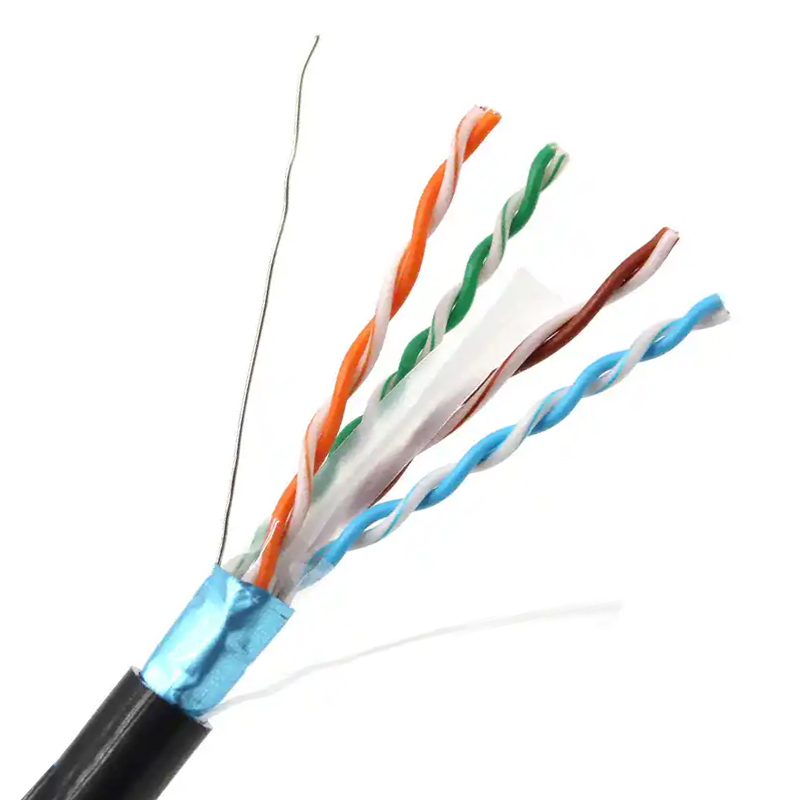
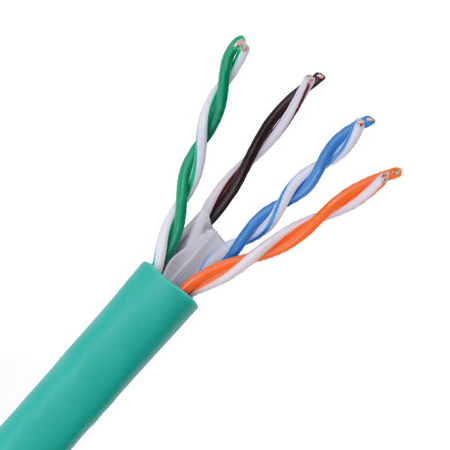
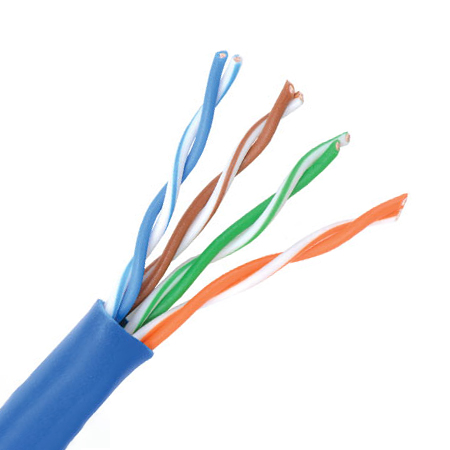
Product Overview
Category 5/5E/6/6E cable, commonly referred to as Cat 5/5E/6/6E, is a twisted pair cable for computer networks. Each category offers different performance levels in terms of frequency, transmission speed, and crosstalk protection.
Category 5 – CAT5
Category 5 transmits at 100 MHz frequencies, providing a rated line speed of up to 100 Mbit/s and a max cable segment length of 100 meters. Most Category 5 cables, designed for early networks, only used two twisted pairs. Older Category 5 cables continue to make up the bulk of the world’s network infrastructure.
Category 5E – CAT5E
An improved specification to Category 5 was later introduced. By reducing noise and signal interference, CAT5E was capable of increasing rated transfer speeds to 350 Mbit/s over 100 meters. The new standard also required all cables to include four twisted pairs (all eight contacts). An optimized encoding scheme allows up to 50-meter lengths of CAT5E cable to perform at, or near, Gigabit Ethernet (1000BASE-T) speeds.
Category 6 – CAT6
The mainstream adoption of Gigabit Ethernet (1000BASE-T) required new industry-standard cables capable of transmitting at a higher frequency of 250 MHz. Category 6 cable uses thicker-gauge wire, increased shielding, and more pair twists per inch to reduce signal noise and interference. The tighter specifications guarantee that 100-meter runs of Category 6 are capable of 1000 Mbit/s transfer speeds. 10-Gigabit Ethernet speeds are achievable when reducing cable lengths to less than 50 meters.
Category 6E – CAT6E (also known as Category 6a)
Category 6 Enhanced (6E) is an augmented specification designed to double transmission frequency to 500 MHz. By wrapping CAT6E in grounded foil shielding, full 10-Gigabit Ethernet speeds can be reached without sacrificing the max cable length of 100 meters.
Standards & Approvals:
-
ISO/IEC 11801
-
IEC 61156-5
-
EN 50173
-
EN 50288-3-1
-
TIA/EIA-568-B
Technical Data
| Property | Value |
|---|---|
| Temperature range during installation | 0°C to +50°C |
| Temperature range fixed installed | -20°C to +60°C |
| Nominal voltage | 300V |
| Minimum inner bending radius | 4D |
Specifications
| Property | Details |
|---|---|
| Voltage Level | Low Voltage (300V) |
| UV Resistance | ✓ (PE black, UV-resistant sheath) |
| LSZH Option | ✓ (LSHF, LSOH, FRNC available) |
Construction
-
Conductor: Copper conductor, single wire 24 AWG
-
Insulation: Polyethylene (PE)
-
Taping: Plastic tape
-
Screen: Copolymer coated Al-tape, bonded to the PE-sheath
-
Sheath: PE black, UV‑resistant (LSHF, LSOH, FRNC available)
Technical Parameters – Ethernet Cable Performance Summary
Specifications Comparison (Cat 3 to Cat 7)
| Category | Shielding | Max Transmission Speed (at 100 meters) | Max Bandwidth |
|---|---|---|---|
| Cat 3 | Unshielded | 10 Mbps | 16 MHz |
| Cat 5 | Unshielded | 10/100 Mbps | 100 MHz |
| Cat 5e | Unshielded | 1000 Mbps / 1 Gbps | 100 MHz |
| Cat 6 | Shielded or Unshielded | 1000 Mbps / 1 Gbps | >250 MHz |
| Cat 6a | Shielded | 10000 Mbps / 10 Gbps | 500 MHz |
| Cat 7 | Shielded | 10000 Mbps / 10 Gbps | 600 MHz |
CAT5, CAT5e, and CAT6 UTP (Solid Cable) Specifications Comparison
| Parameter | Category 5 | Category 5e | Category 6 |
|---|---|---|---|
| Frequency | 100 MHz | 100 MHz | 250 MHz |
| Return Loss (Min. at 100 MHz) | 16.0 dB | 20.1 dB | 20.1 dB |
| Characteristic Impedance | 100 ohms ± 15% | 100 ohms ± 15% | 100 ohms ± 15% |
| Attenuation (Min. at 100 MHz) | 22 dB | 22 dB | 19.8 dB |
| NEXT (Min. at 100 MHz) | 32.3 dB | 35.3 dB | 44.3 dB |
| PS‑NEXT (Min. at 100 MHz) | no specification | 32.3 dB | 42.3 dB |
| ELFEXT (Min. at 100 MHz) | no specification | 23.8 dB | 27.8 dB |
| PS‑ELFEXT (Min. at 100 MHz) | no specification | 20.8 dB | 24.8 dB |
| Delay Skew (Max. per 100 m) | no specification | 45 ns | 45 ns |