
Product Overview
The Type 66 flexible copper screened mining cable is a high-performance power cable engineered for the most demanding open cast mining applications. Designed and manufactured in accordance with stringent South African National Standards (SANS), this cable combines exceptional flexibility with robust copper braid screening and a bonded dual-layer sheath system for superior torsional protection. It is specifically suitable for reeling purposes and is ideal for powering electrically driven machines, movable apparatus in hazardous areas, and medium to large-scale mining equipment.
Applications
-
Electrically driven machines and movable electric apparatus in hazardous areas
-
Portable electric apparatus and section feeders
-
Open cast mining equipment including medium-sized draglines, shovels, and drills
-
Suitable for reeling purposes
-
Other industrial applications requiring flexible, screened, reelable cables
Standards
-
SANS 1520-2 – Electric cables – Reeling and trailing for mines and quarries
-
SANS 1411-1 – Conductors for insulated electric cables and flexible cords
-
SANS 1411-3 – Insulating and sheathing materials for electric cables
Characteristics
-
Excellent Flexibility: Class 5 tinned annealed copper conductors for superior flex life
-
Mechanical Robustness: Abrasion resistant, tear resistant, and flame retardant
-
Wide Temperature Range: Minimum ambient temperature -25°C; maximum conductor temperature +90°C
-
Environmental Resistance: UV, sunlight, ozone, and oil resistant
Specifications
| Parameter | Details |
|---|---|
| Voltage Rating | 1.9/3.3 kV、3.3/3.3 kV、3.8/6.6 kV |
| Cold Resistance | -25°C |
| UV Resistance | Yes |
| Working Temperature | 90°C (conductor) |
| Oil Resistance | Yes |
| Flame Retardant | Yes |
Construction
The Type 66 cable features a sophisticated multi-layer construction engineered for maximum durability and torsional protection in reeling applications:
| Component | Description |
|---|---|
| Conductor | Flexible Class 5 tinned annealed copper wires, stranded with left-hand lay, complying with SANS 1411-1. Each conductor is covered with a semi-conducting rubber screen. |
| Insulation | Ethylene propylene thermosetting compound type RD 3, complying with SANS 1411-3, with a strippable semi-conducting core screen applied via triple extrusion. |
| Insulation Screen | Braid of tinned copper wires applied over the insulation screen. |
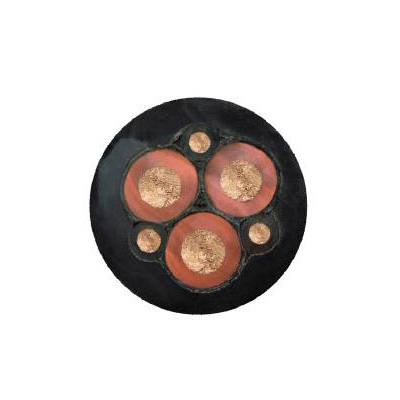
| Cable Assembly | Three tinned copper/nylon braid screened power cores and three unscreened pilot cores (one in each interstice) laid up with right-hand lay around a semi-conductive filler centre. Alternatively, one pilot can be replaced with a tinned ECC conductor (semi-conductive rubber covered). |
| Internal Sheath | Polychloroprene thermosetting compound type RS 6, complying with SANS 1411-3. |
| Reinforcing Braid | An open nylon braid comprising a minimum of 16 nylon strings. |
| Outer Sheath | Polychloroprene thermosetting compound type RS 6, complying with SANS 1411-3. Inner and outer sheath are bonded to provide proper torsional protection. |
| Colour of Sheath | Black (standard). |
Key Features
-
Designed for Reeling: Engineered specifically for applications involving frequent winding, unwinding, and torsional stress.
-
Copper Braid Screened Power Cores: Each power core features tinned copper/nylon braid screening for effective electrical protection.
-
Bonded Dual Sheath System: Inner and outer PCP sheaths are bonded together, providing exceptional torsional protection and mechanical integrity during reeling operations.
-
Nylon Reinforcing Braid: Open nylon braid with minimum 16 strings adds mechanical strength while maintaining flexibility.
-
SANS Compliance: Fully tested and certified to SANS 1520-2 and related standards, guaranteeing safety and reliability in mining environments.
-
Comprehensive Pilot Configuration: Three unscreened pilot cores (or optional ECC replacement) enable monitoring and control functionality.
-
Superior Environmental Resistance: PCP sheath and EPR insulation provide excellent resistance to oil, UV, ozone, and harsh outdoor conditions.